
Private property
Legal concept of non-governmental ownership foundational to capitalism.

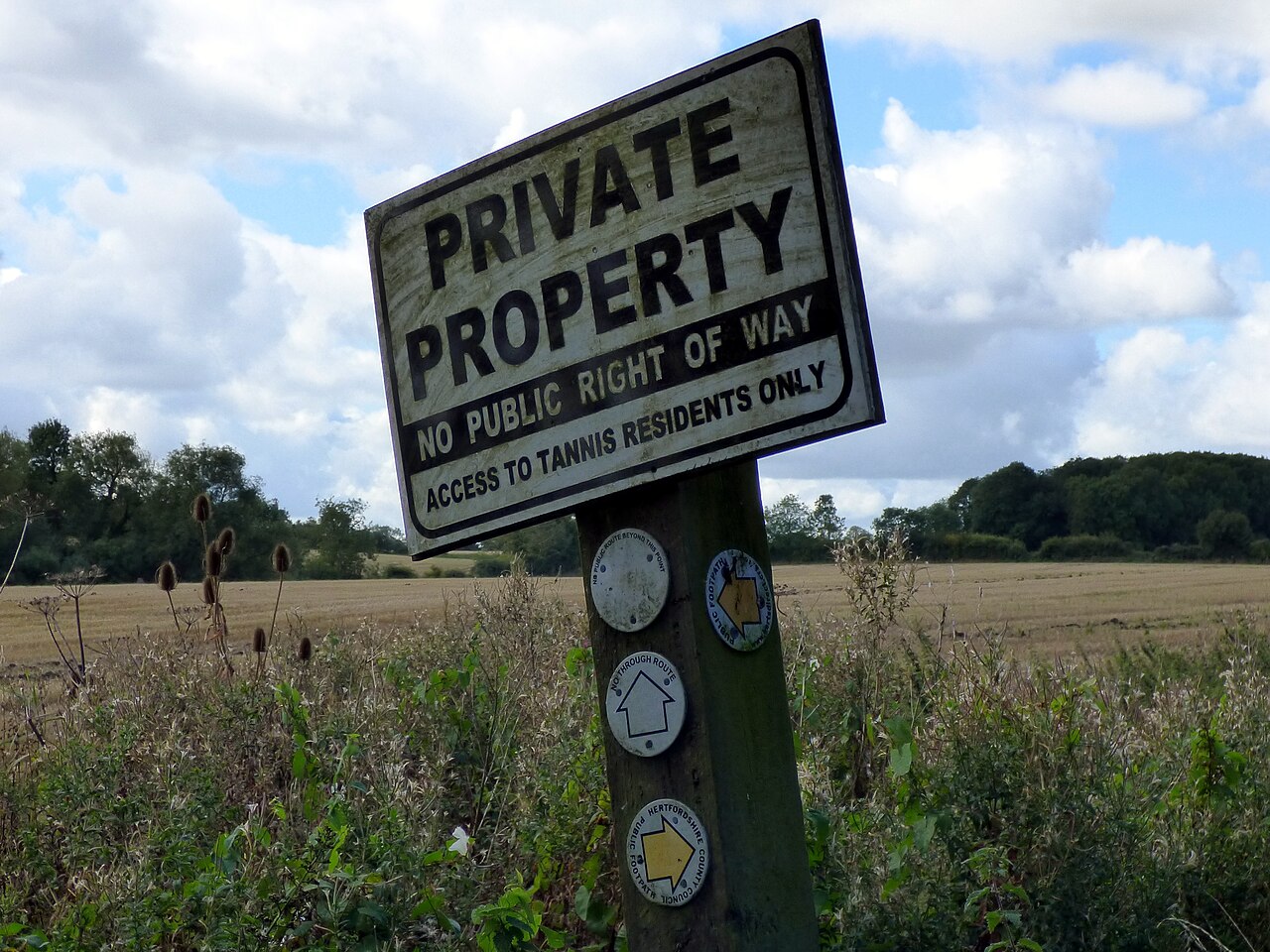
Asamboi · CC BY-SA 4.0
Private property is a legal designation for the ownership of property by non-governmental legal entities. It is distinguishable from public property, owned by a state entity, and from collective or cooperative property, owned by one or more non-governmental entities. Private property is foundational to capitalism, an economic system based on the private ownership of the means of production and their operation for profit. As a legal concept, private property is defined and enforced by a country's political system.
- field
- Legal and economic concept
- known_for
- Foundational institution of capitalism; subject of philosophical debate from Plato through Locke, Smith, Marx, and libertarian economists
- related_concepts
- Public property, collective property, property law, natural rights, labor theory of property
Lore & Background
In absolute antiquity, the native Mesopotamians had no term for the concept of property, yet most of their legal documents concerned the proper disposition of what modern people would call 'property' and ensuring fair treatment of individuals with property claims. Written discussions of private property arguably emerged in the Western tradition at least as far back as Plato. Before the 18th century, English speakers generally used 'property' to refer to land ownership. In England, 'property' came to have a legal definition in the 17th century, and private property as property owned by commercial entities emerged with the great European trading companies of that century. John Locke conceptualized property as a natural right not bestowed exclusively upon the monarchy, arguing in his labor theory that property is a natural result of labor improving upon nature. Adam Smith distinguished between the 'right to property' as an acquired right and natural rights, confining natural rights to 'liberty and life.' Karl Marx provided an influential analysis of property formations and their relationship to technical productive forces, leading to the widespread association of private property in the means of production with capitalism. In the 20th century, libertarian economists such as Ludwig von Mises and Friedrich Hayek emphasized private property as a foundational institution for economic calculation and individual liberty.
Reader's Guide
Private property is a central concept in legal, economic, and political theory, with its definition and enforcement varying by country. The source article traces its philosophical development from Plato through Locke, Smith, Marx, and 20th-century libertarians, noting that Locke saw it as a natural right antecedent to government, while Smith viewed it as an acquired right dependent on civil government. Marx's analysis linked private property in the means of production to capitalism, influencing subsequent economic theories and political movements. The article also notes that contemporary neoclassical economics continues to be influenced by natural rights concepts, presenting private property as 'natural rights' inherent in nature. Economic liberals consider private property essential for a prosperous society, while socialists are critical of private property in the means of production, aiming to replace it with social or public ownership. The legal framework includes property taxes, transfer taxes, and limitations such as building codes and eminent domain. The article preserves the ongoing debate over whether property rights originate from law, custom, contract, or natural rights, without resolving it.
Did You Know?
- The native Mesopotamians had no term for the concept of property, but most of their legal documents concerned the proper disposition of what modern people would call 'property'.
- John Locke argued that private property was antecedent to, and thus independent of, government.
- Adam Smith confined natural rights to 'liberty and life' and distinguished the 'right to property' as an acquired right.
- In the 20th century, libertarian economists such as Ludwig von Mises and Friedrich Hayek emphasized private property as a foundational institution for economic calculation and individual liberty.
The Elusive Definition of Law
Law has long resisted a single, universally accepted definition. Scholars across centuries have offered competing visions: H. L. A. Hart saw it as a structured system of rules; John Austin framed it as a sovereign's command backed by the threat of sanction; Ronald Dworkin treated it as an interpretive concept aimed at achieving justice; Joseph Raz viewed it as an authority that mediates competing human interests. Oliver Wendell Holmes took a more pragmatic stance, describing law simply as predictions of what courts will actually do. Thomas Aquinas, in his Treatise on Law, defined it as a rational ordering directed toward the common good, promulgated by those charged with caring for the community. Glanville Williams added that the word's meaning shifts depending on context, noting that "early customary law" and "municipal law" carry irreconcilable connotations. The term itself traces back to Old Norse lǫg, where the singular lag meant "something laid or fixed."
How Legal Systems Differ Across the World
Legal systems vary significantly between jurisdictions, a difference that comparative law seeks to analyze. In civil law jurisdictions, a legislature or other central body codifies and consolidates the law into comprehensive codes. In common law systems, judges play a more creative role, making binding case law through precedent, though a higher court or the legislature may occasionally overturn such decisions. Religious law operates in some religious communities and states, and has historically influenced secular legal frameworks. The creation of laws themselves may be shaped by a constitution, whether written or tacit, and the rights encoded within it. State-enforced laws can originate from a legislature producing statutes, from the executive issuing decrees and regulations, or from judicial decisions forming precedent. In some political systems, an autocrat may exercise all these functions within their realm. The scope of law divides into two broad domains: public law, which concerns government and society and includes constitutional, administrative, and criminal law; and private law, which addresses disputes between parties in areas such as contracts, property, torts, delicts, and commercial law. This public-private distinction is particularly strong in civil law countries with separate administrative court systems, while it is less pronounced in common law jurisdictions.
The Tension Between Law and Morality
One of the most enduring debates in legal philosophy concerns the extent to which law incorporates morality. John Austin's utilitarian position held that law consists of commands backed by threats of sanctions, issued by a sovereign to whom people habitually obey—entirely separate from moral considerations. Natural lawyers, including Jean-Jacques Rousseau, countered that law reflects essentially moral and unchangeable laws of nature, a concept that first emerged in ancient Greek philosophy alongside the notion of justice and was later reintegrated into Western thought through Thomas Aquinas's writings. Hugo Grotius, the founder of a purely rationalistic natural law system, argued that law arises from both a social impulse and reason. Immanuel Kant believed a moral imperative requires laws to be chosen as though they should hold as universal laws of nature. Jeremy Bentham and his student Austin, following David Hume, criticized this conflation of "is" and "ought," arguing for legal positivism—the view that real law is entirely separate from morality. Friedrich Nietzsche rejected the principle of equality and believed law emanates from the will to power, refusing to label it moral or immoral.
Law as a Force Shaping Society and Scholarship
Law extends far beyond the courtroom, shaping politics, economics, history, and society in numerous ways while also serving as a mediator of relations between people. It provides a rich source of scholarly inquiry spanning legal history, philosophy, economic analysis, and sociology. The philosophy of law, commonly known as jurisprudence, splits into two broad questions: normative jurisprudence asks what law should be, while analytic jurisprudence asks what law is. Law also raises important and complex issues concerning equality, fairness, and justice. In the mid-twentieth century, Hans Kelsen continued the positivist tradition in his Pure Theory of Law, arguing that although law is separate from morality, it is endowed with normativity—meaning we ought to obey it. He proposed that each legal system can be hypothesized to have a basic norm, or Grundnorm, instructing obedience. His major opponent, Carl Schmitt, rejected both positivism and the rule of law, advocating instead a jurisprudence of the exception that denied legal norms could encompass all political experience. Later, H. L. A. Hart attacked both Austin's simplifications and Kelsen's fiction in The Concept of Law, arguing that law is a system of rules divided into primary rules of conduct and secondary rules.
Gallery


Frequently Asked Questions
Who is Private property?
Private property is a legal designation that grants non-governmental entities the right to own and control assets. It sits in contrast to public property held by the state and to collective or cooperative ownership shared among multiple non-governmental parties.
What is Private property's core role in the broader narrative?
It serves as the foundational legal institution underpinning capitalism, the economic system where individuals and firms own the means of production and operate them for profit. Without this concept, the entire capitalist framework loses its structural basis.
How does Private property's story get resolved or enforced?
Its boundaries and protections are ultimately defined and upheld by a country's political and legal system, meaning no single universal rulebook governs it. Different jurisdictions draw the lines of ownership, transfer, and restriction in their own ways.
Why is Private property such a heavily debated character?
Philosophers and economists from Plato through Locke, Adam Smith, Marx, and modern libertarians have all grappled with its legitimacy and scope. It sits at the intersection of natural rights theory, labor theory of property, and competing visions of economic organization.
What are Private property's key allies and rivals in the legal world?
Its closest counterparts are public property (state-owned) and collective or cooperative property (multi-entity non-governmental ownership). It also intersects with broader frameworks like property law, natural rights doctrine, and the labor theory of property.
More in Legal Concepts And Doctrines 1-19
Spotted an error? Know more?
This is a living reference — every entry is fact-audited, and reader corrections feed straight into our audit queue. Suggest an edit · See this site's audit record